
GLP-1 and rapid weight loss: why doctors are increasingly talking about the consequences for the body

Over the past two years, GLP-1 agonist drugs have completely transformed the weight loss and metabolic medicine market. What until recently was perceived as a therapy exclusively for diabetes has turned into a global wellness and longevity trend. Today, these medications are being discussed not only by endocrinologists, but also by influencers, the business community, biohacking groups, and patients who had been unable to lose weight for years. However, alongside the popularity of these drugs, doctors have started facing a new problem. More and more patients are turning to clinics not only with weight loss requests, but also with the consequences of overly rapid weight reduction and the lack of medical supervision. That is why modern medicine is increasingly discussing not only the effectiveness of GLP-1 therapy, but also its impact on muscle mass, hormonal balance, gastrointestinal function, the nervous system, and the overall condition of the body.
WHY GLP-1 BECAME A MEDICAL REVOLUTION
The new generation of drugs works by acting on GLP-1 receptors. They affect the feeling of satiety, blood sugar levels, and the rate of gastric emptying. As a result, appetite decreases, food intake is reduced, and weight begins to drop. For patients with obesity and diabetes, this has truly become a breakthrough. Studies show that modern GLP-1 medications can lead to significant weight reduction and improvement of metabolic indicators. But the problem is that these drugs have started to be used massively far beyond their classical medical indications. Many patients take them on their own, without proper diagnostics, body composition monitoring, or risk assessment.
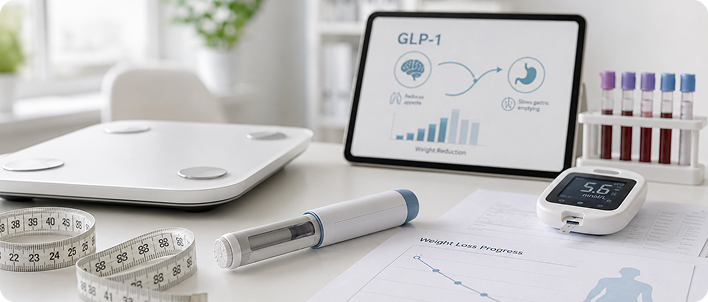

WHAT HAPPENS TO THE BODY DURING RAPID WEIGHT LOSS
One of the main misconceptions is that any weight loss is automatically considered a positive result. In practice, the body loses not only fat tissue. With rapid weight reduction, there can be loss of muscle mass, changes in hormonal balance, metabolic disruption, and reduced bone density. Doctors are also increasingly recording micronutrient deficiencies, gastrointestinal problems, gallbladder dysfunction, and pronounced chronic weakness. Special attention is currently being paid to sarcopenia — the loss of muscle mass against the background of aggressive weight loss. Recent studies show that part of the weight lost during GLP-1 therapy may come precisely from muscle tissue, especially if the patient does not receive enough protein and does not engage in strength training. That is why modern metabolic medicine increasingly emphasizes that the goal is not simply to reduce the number on the scale, but to preserve body quality, metabolic health, and the normal functioning of the body.


WHY MORE AND MORE PATIENTS ARE SEEKING RECOVERY
Against the backdrop of GLP-1 popularity, clinics are increasingly encountering patients who, after rapid weight loss, complain of chronic fatigue, weakness, hair loss, deterioration of skin condition, anxiety, sleep problems, and reduced physical endurance. A separate issue is that many people begin therapy without a full medical examination. At the same time, rapid weight loss can mask or aggravate existing disorders: hormonal imbalances, deficiencies, autoimmune processes, gastrointestinal diseases, and metabolic disorders.
In Germany, there is a dedicated field of metabolic recovery and longevity medicine that deals with the consequences of rapid weight loss, deficiency states, metabolic disorders, muscle mass loss, and chronic exhaustion of the body. Such programs typically include advanced diagnostics, assessment of hormonal status, body composition, gastrointestinal health, inflammation levels, and overall metabolic health. However, in practice, it is not always clear to the patient which diagnostic format they actually need, which center to turn to, and which specialists should be involved in the recovery. Depending on the condition, this may involve endocrinology, gastroenterology, longevity medicine, neurology, restorative therapy, or a comprehensive metabolic rehabilitation program.

Today, doctors increasingly say that the problem lies not in the medications themselves, but in the absence of a systemic medical approach. GLP-1 therapy can indeed be a powerful tool for treating obesity and metabolic disorders. But without diagnostics, monitoring, and professional supervision, rapid weight loss can lead to consequences that subsequently require long-term recovery of the body. That is why more and more patients are turning not only to weight loss programs, but also to comprehensive assessments of the body's condition before and after therapy. In modern preventive and longevity medicine, the key goal is not simply to lose weight, but to preserve muscle mass, a stable hormonal balance, normal gastrointestinal function, metabolism, and overall quality of life.
German Medical Concierge helps build this process into a complete medical strategy. The team analyzes the patient's condition, organizes diagnostics in Germany, selects specialized doctors and clinics, and coordinates metabolic check-ups, recovery programs, and further medical support. This is especially important in cases where rapid weight loss has already led to complications, chronic weakness, deficiencies, hormonal imbalances, or digestive problems. Properly organized diagnostics makes it possible not only to assess the current state of the body, but also to prevent further consequences.