
Early diagnosis of breast cancer in Germany

Breast cancer can develop for a long time without pain or other noticeable symptoms. This is precisely why modern oncology places particular emphasis on early detection of the disease, before any clinical signs appear. The earlier a tumour is found, the higher the likelihood of successful treatment and the more often it is possible to use less intensive forms of therapy. According to the German Federal Ministry of Health, breast cancer remains the most common cancer among women in the country, with around 75,000 new cases diagnosed every year.
In Germany, early breast cancer detection is organised as a multi-level system. It includes organised mammography screening for women of a certain age, clinical examination, additional imaging where indicated, and separate intensive surveillance programmes for women with an increased hereditary risk.
Why it is important to detect breast cancer before symptoms appear
The main purpose of screening is precisely to detect the disease in women who feel healthy and have no complaints. Early detection does not prevent breast cancer from developing, but it makes it possible to find a tumour at a stage when it may not yet cause any symptoms. The German Cancer Information Service at the German Cancer Research Center (DKFZ) emphasises that breast cancer detected at an early stage generally has better treatment options, and the therapy itself is often less intensive.
The effectiveness of organised screening is also confirmed by German data. The results of a long-term evaluation of the national programme, published in 2025, showed that among women in the relevant age group who took part in mammography screening, breast cancer mortality was 20–30% lower than among those who did not participate.
How mammography screening works in Germany
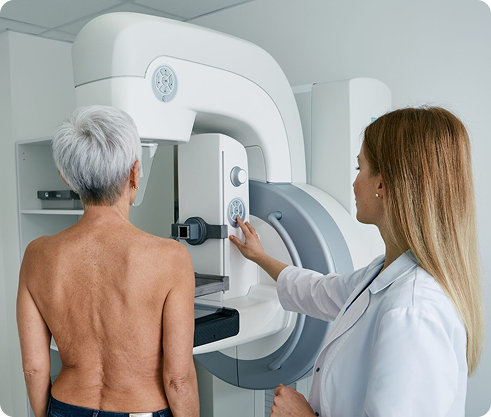
The main method of organised breast cancer screening in Germany is mammography. At present, women between the ages of 50 and 75 are entitled to undergo mammography screening every two years. The programme is intended specifically for women without symptoms. If a suspicious lump, pain, nipple discharge or other changes are already present, this is no longer preventive screening but a diagnostic examination carried out on other medical grounds.
A distinctive feature of the German system is its strict quality control. The examinations are performed in certified screening units. Every mammogram is assessed independently by two specially trained physicians. If a suspicious change is detected, the patient is referred for further diagnostics.
Mammography, ultrasound or MRI: which method is needed
One of the most common patient questions is whether mammography can be replaced by ultrasound examination of the breasts.
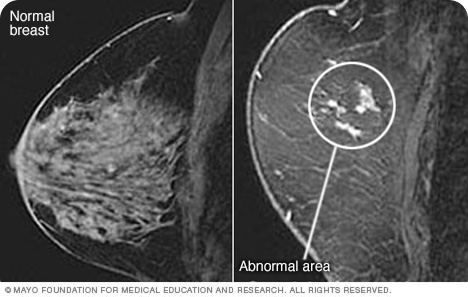
These methods serve different diagnostic purposes. Mammography remains the main method of organised screening. Ultrasound may be used as an additional method, for example to clarify changes that have already been detected or as part of an individual examination programme. Where the risk of breast cancer is increased, the diagnostic strategy may be considerably broader. Depending on age and individual risk, intensive surveillance programmes in Germany may include clinical examination, breast ultrasound, mammography and magnetic resonance imaging.
There is therefore no universal set of examinations suitable for every woman. The diagnostic programme has to take into account age, individual risk, family history and the results of previous investigations.
When family history changes the examination programme
In Germany, particular attention is paid to women whose families have had repeated cases of breast or ovarian cancer, especially at a young age.
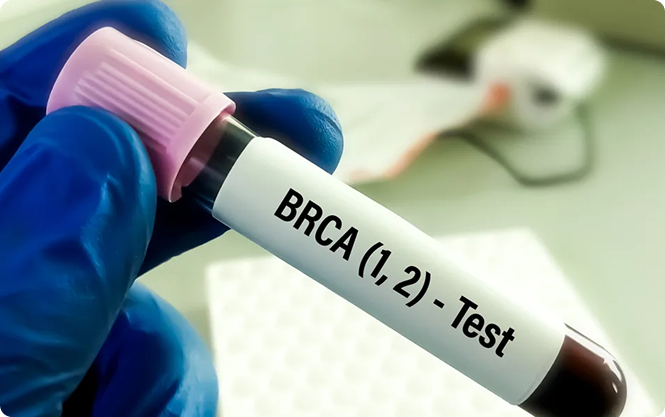
In such situations, the doctor assesses the likelihood of a hereditary predisposition. If the relevant criteria are met, the patient may be advised to consult a medical geneticist and to undergo molecular genetic testing. If a high hereditary risk is confirmed, standard age-based screening may not be sufficient. For such patients, Germany offers specialised intensive early detection programmes, with surveillance carried out in specialised centres, including the centres of the German Consortium for Hereditary Breast and Ovarian Cancer. The frequency and methods of examination are determined individually, depending on the level of risk and the patient's age.
Why a single examination is sometimes not enough
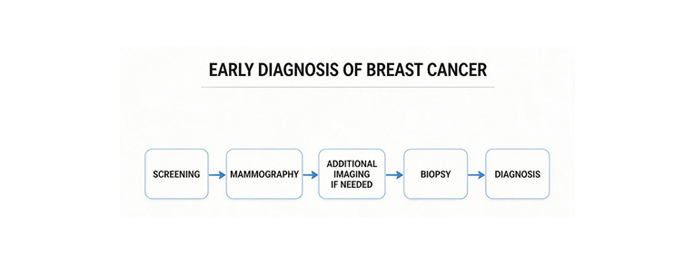
Modern breast cancer diagnostics is built not around a single device or test, but around the correct interpretation of the overall body of data. The radiologist assesses the imaging results. The breast specialist or gynaecologist compares them with the clinical picture. If a hereditary syndrome is suspected, a medical geneticist is involved. If a suspicious lesion is found, further diagnostics may include additional imaging methods and a biopsy with subsequent histopathological examination. It is precisely the multidisciplinary approach that makes it possible not simply to perform the maximum number of tests, but to select the methods that are genuinely necessary for the individual patient.
Who particularly needs individual surveillance
The standard screening programme is designed for a population at average risk. However, there are women for whom the early detection programme has to be designed individually.
This category may include patients with a confirmed hereditary predisposition, a pronounced family history, previously detected breast changes or other factors that significantly increase individual risk. In such situations, the doctor's task is not simply to order more examinations. It is necessary to determine the optimal age at which surveillance should begin, the intervals between examinations and the most informative combination of diagnostic methods. German guidelines provide precisely for a risk-adapted approach to intensive surveillance of women at high risk.
German Medical Concierge
For international patients, arranging breast cancer diagnostics in Germany may require the coordination of several specialists and medical institutions at once.
German Medical Concierge helps to organise this process as a single medical strategy. The team analyses the available medical documentation, selects specialised centres and specialists in Germany, and arranges diagnostics, consultations, genetic testing where appropriate indications exist, and second medical opinions. If suspicious changes are found during the examination, German Medical Concierge helps to arrange further diagnostics and to select a specialised centre in order to define the optimal treatment strategy.
Early breast cancer detection in Germany is not based on the principle that "the more tests, the better". Its foundation is the right examination method at the right time, taking into account each woman's individual risk. Mammography screening, modern imaging, genetic diagnostics and specialised surveillance programmes make it possible to detect the disease before symptoms appear and to make medical decisions at the earliest possible stage.