
Hashimoto's disease: diagnosis and treatment in Germany

Hashimoto's thyroiditis is an autoimmune disease of the thyroid gland and one of the most common causes of hypothyroidism. The immune system mistakenly recognises the structures of the thyroid gland itself as foreign, chronic inflammation develops, and over time the gland may lose its ability to produce a sufficient amount of thyroid hormones. One of the difficulties of the disease is that this process usually develops gradually. For a certain period, the remaining functional thyroid tissue is able to compensate for the changes, which is why a pronounced hormone deficiency does not appear immediately. This is precisely why a considerable amount of time may pass between the onset of the autoimmune process and clinically significant hypothyroidism.
Why Hashimoto's symptoms are easily confused with other conditions
Fatigue, reduced performance, difficulty concentrating, low mood, sensitivity to cold, dry skin, hair loss and weight gain are not specific to thyroid disease alone. Such complaints can occur in many other conditions. The German federal health information portal specifically notes that hypothyroidism symptoms can be mistakenly attributed to other diseases or even to age-related changes. This is why a diagnosis cannot be made solely on the basis of how a patient feels. This is especially important in the case of non-specific complaints. Persistent fatigue or weight gain on their own do not necessarily mean that Hashimoto's disease is present.


How Hashimoto's disease is diagnosed in Germany
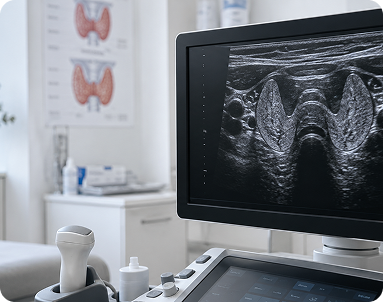
The German approach does not start with ordering the maximum possible number of tests, but with assessing thyroid function and the clinical picture. One of the main laboratory parameters is TSH, the thyroid-stimulating hormone that regulates thyroid activity. If necessary, free T4 is additionally determined. If it is necessary to establish the autoimmune nature of the changes, antibodies are tested, primarily TPO antibodies (TPO-Ab). Depending on the clinical situation, the endocrinologist may supplement the work-up with other laboratory tests and a thyroid ultrasound. Even an elevated TSH must be interpreted correctly. German guidelines emphasise that a slight increase in this value does not always indicate a disease requiring immediate treatment. What matters is the patient's age, symptoms, free T4 level, presence of antibodies, coexisting conditions, medications taken and the dynamics of the laboratory values over time.

Antibodies have been detected. Does this mean treatment is needed?
Antibodies help to establish the autoimmune nature of the disease, but a decision on therapy should not be made simply because the TPO-Ab value exceeds the laboratory reference range. The German DEGAM guideline explicitly states that labelling a patient as pathological solely on the basis of TSH or TPO values outside the reference range is not justified. The endocrinologist's task is therefore not to "treat the antibodies", but to determine whether thyroid function is actually impaired and whether the patient requires replacement therapy.
When treatment is prescribed
If Hashimoto's disease leads to hypothyroidism, the main therapy is levothyroxine, a synthetic analogue of thyroxine. It compensates for the deficiency of thyroid hormone and helps to normalise metabolic processes. The dosage is selected individually, taking into account body weight, age, laboratory values, general condition and coexisting diseases. After starting therapy, the parameters are monitored and the dosage is adjusted if necessary. This is particularly important because an excessive dose of thyroid hormone is also undesirable and, in particular, may place additional strain on the cardiovascular system. The situation is more complex in subclinical hypothyroidism. The decision to start therapy depends on the TSH level, age, symptoms, TPO antibodies, pregnancy or its planning, and other individual factors. German guidelines therefore do not regard a single laboratory value as a universal basis for treatment.


What to do if symptoms persist despite a normal TSH
If, on properly adjusted therapy, thyroid function values have normalised but fatigue, hair loss, weight gain, concentration problems or other complaints persist, the hormone dose should not be automatically increased. Other possible causes of the symptoms need to be assessed. Depending on the clinical situation, the doctor may check for anaemia or deficiency states, evaluate metabolism, coexisting autoimmune diseases, sleep quality, medications taken and other factors. This is exactly where comprehensive endocrinological diagnostics becomes particularly important: the doctor's task is not only to normalise the TSH figure, but also to understand whether the persisting complaints are actually related to the thyroid gland.
Hashimoto's disease and weight gain

Weight gain can indeed accompany hypothyroidism. When thyroid hormones are deficient, metabolic processes slow down, and mild to moderate weight gain may be one of the manifestations of the disease. However, the claim that Hashimoto's disease necessarily causes a weight gain of 5 or 10 kilograms would be medically inaccurate. If thyroid function is compensated, significant weight gain requires the search for additional causes. This is essential for patients to understand: not every change in weight should be attributed to Hashimoto's disease, nor should it be addressed by increasing the hormone dose.
Why making the diagnosis is not the only important step in Hashimoto's disease
Hashimoto's disease is a chronic condition, which is why the endocrinologist evaluates the patient over time. Thyroid function may change gradually, and the need for replacement therapy may change accordingly. Once a stable levothyroxine dose has been established, monitoring is usually required much less frequently. The German federal health information portal states that once therapy has been stabilised, annual monitoring of the parameters is often sufficient. This is precisely why high-quality treatment of Hashimoto's disease does not consist of a large number of tests, but of accurate diagnosis, well-founded prescription of therapy and ongoing follow-up.
German Medical Concierge



For international patients, consulting a German endocrinology centre is particularly relevant in cases of an unclear diagnosis, conflicting test results, persisting symptoms despite treatment, or the need to obtain a second medical opinion.
German Medical Concierge helps to arrange consultations with endocrinologists and examinations in Germany, to forward the available medical documentation to specialists, to obtain a second opinion and to develop a further diagnostic or treatment strategy.
In Hashimoto's disease, it is particularly important to distinguish a confirmed impairment of thyroid function from symptoms that may have a completely different cause. Modern German endocrinology is built precisely on this principle: to treat not an isolated laboratory value, but the disease of the individual patient.