
Influenza, RSV and COVID-19: how Germany protects high-risk patients

Autumn traditionally marks the beginning of the respiratory infection season. For most healthy people, influenza, COVID-19 or RSV end in recovery without serious consequences. However, for elderly people, patients with chronic diseases, immunodeficiencies, and certain cardiovascular and pulmonary diseases, a common seasonal infection can lead to a severe course, hospitalisation and decompensation of the underlying disease.
In Germany, the prevention of seasonal infections is built primarily around protecting patients at increased risk of complications. Recommendations are developed by the Standing Committee on Vaccination (STIKO) at the Robert Koch Institute, while the epidemiological situation in the country throughout the season is monitored by the RKI. Separately, the availability, quality and safety of vaccines are overseen through the Paul-Ehrlich-Institut.

Why autumn is especially important for high-risk patients
The season of different respiratory viruses does not begin at the same time. For example, RSV usually circulates most actively in autumn and winter, traditionally from October to March. The influenza wave also occurs predominantly during the winter months.
For a patient with a chronic disease, the problem lies not only in the infection itself. Acute respiratory diseases can place an additional burden on the body and increase the likelihood of complications. Therefore, the German strategy is not to wait for the epidemic season to begin, but to identify individual risk factors in advance and check which prevention is recommended for a particular patient.
Who is considered to be at increased risk in Germany
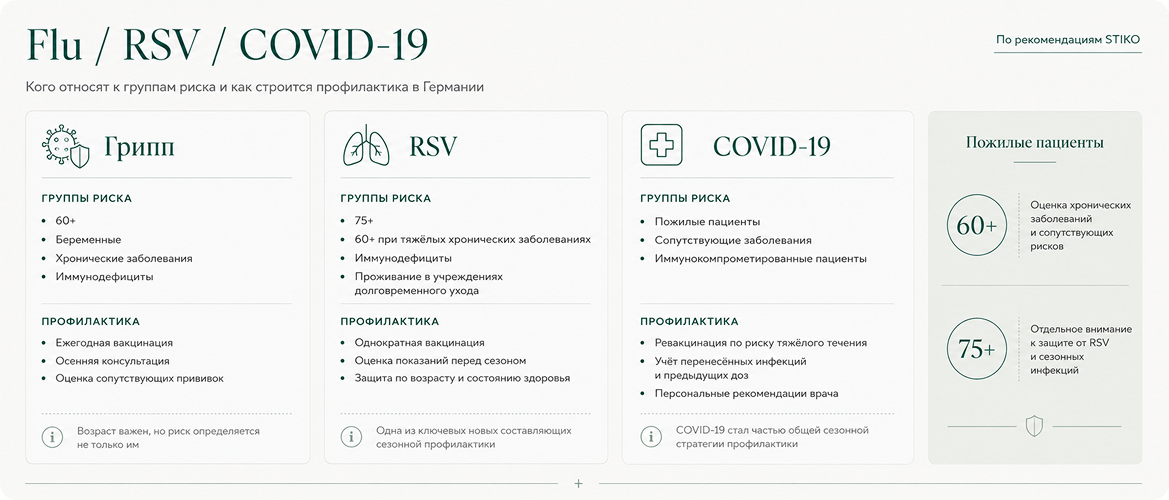
Recommendations differ depending on the infection. Annual vaccination against influenza in Germany is recommended, in particular, for people over 60, pregnant women, patients with certain chronic diseases and people with immunodeficiencies. Among the diseases that increase the risk of influenza complications, the RKI lists chronic diseases of the lungs, cardiovascular system, liver and kidneys, diabetes and other metabolic diseases. This is an important feature of the German approach: prevention is determined not only by the patient's age. For a young person with a serious chronic disease, the recommendations may differ significantly from those for a healthy person of the same age.

Influenza: why the vaccine changes every season
Influenza viruses are constantly changing, so the composition of the seasonal vaccine is regularly adapted. The Paul-Ehrlich-Institut publishes information about the vaccines available for a particular season in Germany. For the 2025/2026 season, vaccines with an updated strain composition were used in the country. This is precisely why influenza vaccination is annual. Last year's vaccine does not replace vaccination before the new season. For a high-risk patient, an autumn consultation can be an opportunity to simultaneously check protection not only against influenza, but also against COVID-19, RSV and pneumococcal infection, if the corresponding prevention is indicated by age or state of health. This approach is directly reflected in the information provided by the Federal Ministry of Health of Germany.
COVID-19: vaccination is now focused primarily on the risk of severe disease
After the end of the pandemic phase, the approach to COVID-19 has changed. Today in Germany, COVID-19 prevention is built primarily taking into account the individual risk of a severe course of the disease. Therefore, it is important for the doctor to assess the patient's age, previous vaccinations and past infections, comorbidities and the state of the immune system. For patients in risk groups, the question of seasonal revaccination is considered in accordance with the current STIKO recommendations. Thus, COVID-19 has gradually become part of a broader strategy for the prevention of seasonal respiratory infections, rather than a separate emergency programme.

RSV: one of the main new components of seasonal prevention
The German prevention system has changed especially noticeably after the emergence of new possibilities for protection against RSV.
RSV is often perceived solely as a childhood infection. However, the virus can pose a serious danger to elderly people as well. According to the Federal Ministry of Health of Germany, people over 75 are at especially high risk of severe disease, as well as some patients over 60 with severe chronic diseases or immunodeficiency.
STIKO recommends a single vaccination against RSV for all people aged 75 and over. For patients aged 60 and over, vaccination is recommended in the case of certain severe chronic diseases, as well as for those living in long-term care facilities.
Thus, before the start of the autumn-winter season, the doctor can assess several risks at once and determine whether the patient requires protection against influenza, COVID-19, RSV or a combination of several preventive measures.
How Germany protects infants from RSV
A separate strategy exists for the youngest patients.
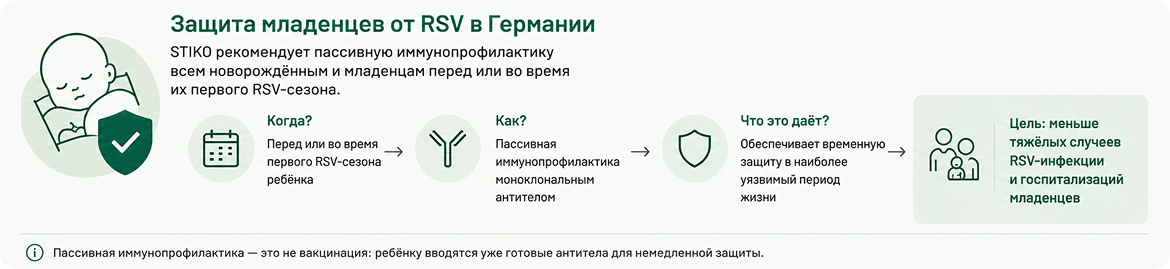
RSV is one of the most significant causes of hospitalisation of infants with respiratory infections. Therefore, STIKO recommends protection against RSV for all newborns and infants before or during their first RSV season. For this purpose, passive immunoprophylaxis with a monoclonal antibody is used. This is fundamentally different from classical vaccination: the child is given ready-made antibodies, providing temporary protection during the most vulnerable period of life.
Why patients with chronic diseases need an individual plan
There is no universal calendar of "three vaccinations for everyone".
A patient after a transplant, a person receiving immunosuppressive treatment, a patient with an oncological disease or an elderly person with heart failure may require an individual assessment. The doctor takes into account the diagnosis, age, medications taken, state of the immune system, previous treatment and vaccination history. It is especially important to coordinate the timing of prevention in patients receiving therapy that can affect the immune response. This is precisely why, for complex patients, preparation for the infection season becomes part of the overall medical strategy, rather than simply a matter of scheduled vaccination.


Not only vaccination: how Germany monitors the infection season
Another feature of the German system lies in continuous epidemiological monitoring. The Influenza Working Group of the Robert Koch Institute monitors the spread of acute respiratory diseases in Germany and regularly publishes data on the activity of respiratory infections. On the basis of such a system, one can see the onset and dynamics of seasonal waves.
During high circulation of viruses, additional measures can be especially important for vulnerable patients. The Federal Ministry of Health of Germany indicates that a properly used medical mask indoors can serve as additional protection during periods of high activity of influenza, COVID-19 and RSV, especially for people in risk groups.
German Medical Concierge
For foreign patients with chronic diseases, preparation for the infection season may require consultation with a specialist doctor, especially if the person is undergoing oncological treatment, receiving immunosuppressive therapy, has had a transplant or has serious diseases of the heart, lungs or other organs. German Medical Concierge helps to arrange consultations with specialists and examinations in Germany, obtain a second medical opinion and develop a medical strategy taking into account the underlying disease and the patient's individual risk factors.
The modern German approach to the prevention of seasonal infections is based not on the principle of "the same vaccination for everyone", but on the assessment of individual risk. Influenza, COVID-19 and RSV are considered as different infections requiring different protection strategies. For the most vulnerable patients, such prevention becomes a full-fledged part of medical support before the autumn-winter season.